

Alethio Therapeutics, spun out of the University of Oxford in 2021, has raised $90 million (£67 million) to take its first blood cancer antibody into human trials.
Alethio Therapeutics, a blood cancer company spun out of the University of Oxford, has raised $90 million (£67 million). The money will pay for the first trials of its lead drug in patients.
The company announced the Series A funding round on Thursday 5 November. Its announcement was published in full by Sofinnova Partners, one of the two lead investors. It described the round as oversubscribed.
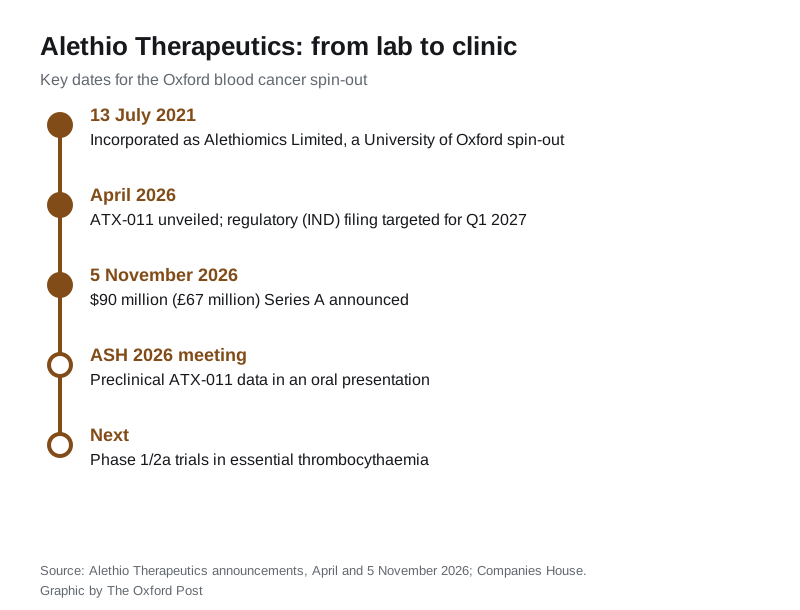
Alethio was founded by Professors Adam Mead and Beth Psaila, two Oxford physician-scientists who specialise in a group of blood cancers called myeloproliferative neoplasms, or MPNs. The company’s registered office is at Sovereign House on Abingdon Science Park, about seven miles south of Oxford city centre. Companies House records it was incorporated on 13 July 2021 under its former name, Alethiomics Limited.
Who is putting the money in
The round was co-led by two new investors. Oxford backers already in the company joined them. According to the announcement, the investors are:
- Sofinnova Partners, co-lead
- RA Capital, co-lead
- Oxford Science Enterprises, the university’s investment company and a founding investor in Alethio
- Cancer Research Horizons, the innovation arm of Cancer Research UK
- the University of Oxford
Graziano Seghezzi, Managing Partner at Sofinnova Partners, and Maxwell DeNies of RA Capital have joined Alethio’s board.
What the drug does
The lead drug is an antibody called ATX-011. It is aimed at essential thrombocythaemia (ET), an MPN in which the bone marrow makes too many platelets. The company says people with ET face a higher risk of blood clots, bleeding, scarring of the bone marrow (myelofibrosis) and, in some cases, acute leukaemia.
Current treatments include hydroxycarbamide, interferon and anagrelide. The company says these control blood counts for some patients but are not targeted at the cells that drive the disease, and can damage healthy cells too.
ATX-011 binds a protein called G6B. The company says G6B is found on platelets and on the stem cells that start MPNs, but not on healthy stem cells. The aim is to remove the cells driving the disease and bring platelet counts back to normal, whatever genetic mutation a patient carries.
“Too often, a patient’s first encounter with ET is a thrombotic event that lands them in the emergency room,” said Dr Rohit Batta, Alethio’s chief executive. He said the treatments that follow are often lifelong, can cause burdensome side effects and are associated with high rates of resistance.
Sally Dewhurst, Principal at Oxford Science Enterprises, said the company had made “incredible progress in translating pioneering University of Oxford science into a focused and ambitious biotechnology company”.
How far off is a treatment?
ATX-011 has not yet been given to patients. The company says it is still in IND-enabling studies, the laboratory and safety work needed before a drug regulator will allow human trials.
In April 2026, Alethio said it was targeting that regulatory filing, an Investigational New Drug application in the United States, for the first quarter of 2027.
The new money is meant to take ATX-011 through Phase 1/2a trials in ET, up to the point where a larger Phase 3 trial could begin. It will also fund work on other MPN drugs. The company says its preclinical results for ATX-011 have been chosen for an oral presentation at the American Society of Hematology’s 2026 annual meeting.
Funding is not a result. Early trials exist to test whether a drug is safe and whether it works in people, and many promising laboratory candidates fail at that stage.
What it means for you
- If you or someone you care for has ET or another MPN: there is no Alethio trial recruiting yet, and the company has not said where its first trials will run. Your haematology team can tell you which trials are open now. The NIHR’s Be Part of Research service lists UK studies by condition.
- Treatment stays the same for now. Nothing in this announcement changes current care. Do not stop or change any medicine without talking to your doctor.
- For Oxfordshire: it is another large round for a company built on University of Oxford research, based within commuting distance of the city. The announcement does not say whether Alethio plans to hire locally or how many people it employs.
Have your say