
Oxford is set to get a Thames Valley mayor, elected in 2028, after the Budget put the region back on the devolution list with £9.1m. The county has doubts.
Oxford is on course to get an elected mayor for the Thames Valley, with the first election planned for 2028. The government put the region on its list for a new mayoral strategic authority in the Budget on Wednesday 28 October.
The authority would cover 13 councils across Berkshire, Oxfordshire and Swindon. It comes four months after the last attempt at a Thames Valley body collapsed in a row between Oxford City Council and Oxfordshire County Council.
The two councils have welcomed it in very different tones. The city’s leader called it “a once-in-a-generation opportunity”. The county’s leader said he has “serious, unanswered questions”.
What was announced
Oxford City Council and Oxfordshire County Council both published the news on 28 October. Their releases say:
- The Chancellor, John Healey, named the Thames Valley in his Budget statement as one of the areas that “will progress with plans” for a mayoral strategic authority.
- The region gets a proposed £9.1 million from the government’s Good Growth Funds while the authority is set up.
- Council leaders across Berkshire, Oxfordshire and Swindon wrote to the devolution minister, Jim McMahon, earlier in the week to confirm they wanted one.
- The 13 councils will now draw up a proposal, with a public consultation planned for the new year.
(Oxford City Council, 28 October 2026; Oxfordshire County Council, 28 October 2026)
The two releases do not agree on how many other areas were named alongside the Thames Valley. The city says nine, the county says seven. Both list Surrey, Hertfordshire and Wessex.
The government’s own funding table settles the money. It lists 14 areas in the same position, all getting transitional cash “contingent on an agreed devolution deal and geography by 2027 to 2028”. The Thames Valley’s £9.10 million is the second largest, behind Hampshire and Solent. (GOV.UK, Good Growth Funds: place selection and indicative allocations, 28 October 2026)
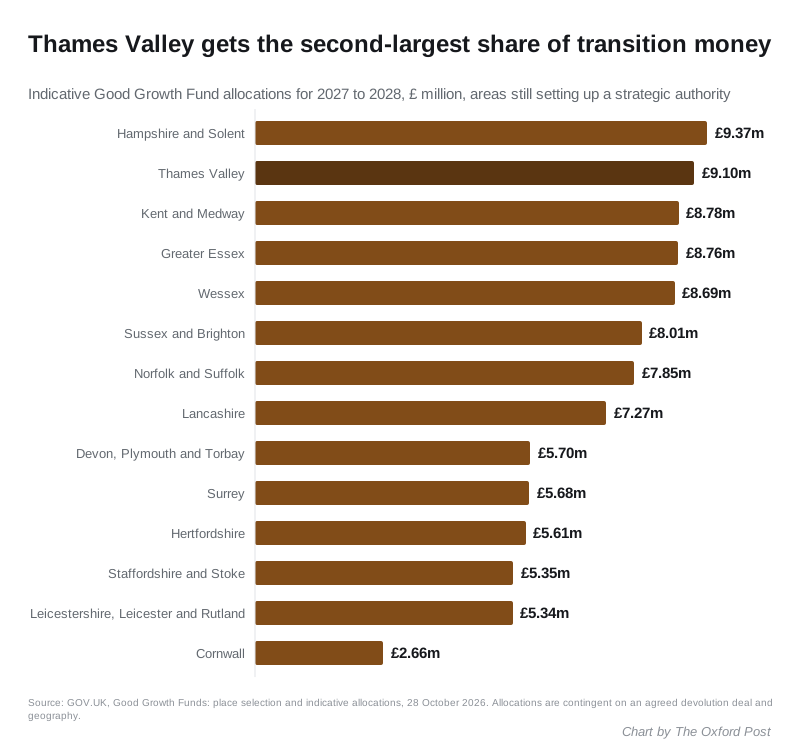
The full list, from the same table: Hampshire and Solent £9.37m, Thames Valley £9.10m, Kent and Medway £8.78m, Greater Essex £8.76m, Wessex £8.69m, Sussex and Brighton £8.01m, Norfolk and Suffolk £7.85m, Lancashire £7.27m, Devon, Plymouth and Torbay £5.70m, Surrey £5.68m, Hertfordshire £5.61m, Staffordshire and Stoke £5.35m, Leicestershire, Leicester and Rutland £5.34m, and Cornwall £2.66m.
The timetable
The councils’ releases set out the steps. Each depends on the one before.
| When | What happens |
|---|---|
| December 2026 | A draft proposal goes to councils across the region, which are asked to approve a consultation |
| New year 2027 | Public consultation |
| Spring 2027 | Formal proposal submitted to the government |
| Later in 2027 | The authority is set up in shadow form, after the legal process |
| 2028 | First mayoral election |
What a mayor would and would not run
The councils say the authority would have “more funding and control” over:
- transport
- skills and employment support
- inward investment
- affordable housing
It would be led by the elected mayor and a board made up of representatives from every upper-tier council in the area.
Your bins, social care, housing, schools, leisure centres and planning applications stay with your local council, the releases say.
The government’s Budget fact sheet adds more for mayors in general. It promises income tax assignment for all mayors from 2028, a share of business rates, and a law giving every strategic authority the power to bring in an overnight visitor levy. (GOV.UK, Budget 2026 fact sheet: Delivering for every region)
That last point matters in Oxford. As we reported in September, a tourist tax on hotel stays can only be set by a strategic authority, at one rate across its whole area. Oxford City Council cannot set one of its own. A Thames Valley mayor would be the body that decides.
What the two leaders said
Councillor Susan Brown, leader of Oxford City Council, said:
“This is a once-in-a-generation opportunity to bring investment into the growing economies of Oxford, Oxfordshire and the wider Thames Valley to support much needed infrastructure and housing and ensure that economic growth is well managed and works for everybody.”
She said the city had been in talks with the government “for two years”. She also said the authority “would unlock an investment fund potentially worth hundreds of millions of pounds”. Neither release gives a figure beyond the £9.1 million.
Councillor Tim Bearder, leader of Oxfordshire County Council, said devolution was “an opportunity worth pursuing”. But he listed three worries:
- Buckinghamshire is not in it. He is “particularly concerned about Buckinghamshire’s absence, given our longstanding economic and public service relationships across the Thames Valley”.
- Police, NHS and fire boundaries. The government has said public service boundaries should line up with the new authority. “The implications for policing, the NHS and fire and rescue services could be significant,” he said.
- Two upheavals at once. The county is also facing the government’s plan to replace Oxfordshire’s councils. “We are being asked to undertake major structural changes to our councils at the same time as establishing a new strategic authority,” he said.
“The ultimate deal must be one worth having,” he added.
How we got here
This is the second go at a Thames Valley authority this year. Oxfordshire County Council’s devolution page records that leaders sent the government expressions of interest in December 2025 and March 2026. In June, it says, “leaders were unable to reach agreement”. (Oxfordshire County Council, About devolution)
The city council blamed the county. It said the new county leader vetoed the plan at the meeting meant to finalise it, a day after the minister had endorsed it. (Oxford City Council, 1 July 2026)
This time both councils’ releases say leaders across the region wrote to the minister together to confirm they want an authority.
What it means for you
- Nothing changes yet. No mayor, no new tax and no change to your council services until at least 2028.
- You will get a say. The consultation is planned for the new year. We will publish the dates and the proposal when the councils release them.
- Your vote in 2028. If the plan goes through, Oxford residents would vote for a mayor of an area stretching from Swindon to Slough.
- Watch the county. Oxfordshire County Council must approve the consultation in December. Its leader has said he will “challenge proposals that do not serve our residents’ interests”.
The councils point to a shared page for updates: reading.gov.uk/devolution.
Have your say