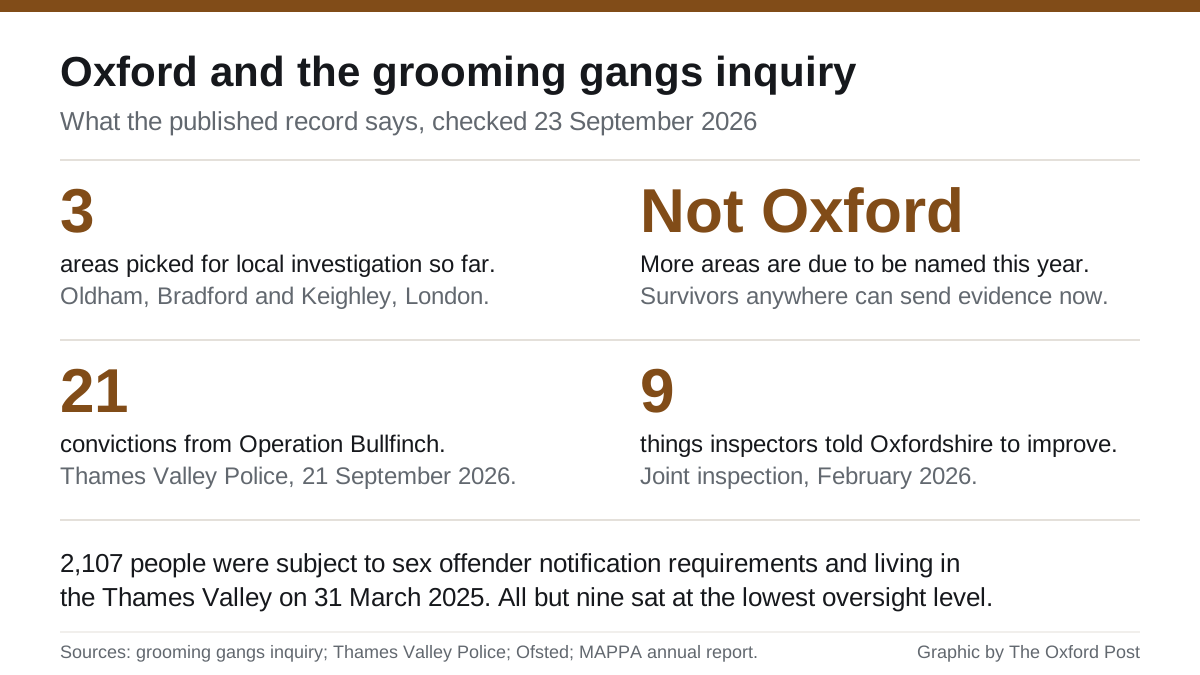

Oxford is not one of the three areas the national grooming gangs inquiry picked first. Further areas are due this year, and survivors can send evidence now.
Oxford is not one of the areas the national grooming gangs inquiry has chosen to investigate. The inquiry has named three so far: Oldham, Bradford and Keighley, and London. It says more will follow, and it has not said when.
That is the position on the inquiry’s own local investigations page, checked today. The three were announced on 24 June, when the inquiry said further areas would be announced later this year.
The question is live in Oxford again because Thames Valley Police published a statement on Monday afternoon about a BBC Panorama programme on the experiences of three women abused in Oxfordshire in the early 2000s. This article does not report that programme. It reports what the force, the inspectorates and the inquiry have themselves published, which is where the answers a resident actually needs are recorded.
What the force said on Monday
Thames Valley Police put out its response at 4.32pm on 21 September, before the programme aired. It accepts, in its own words, that the programme “highlights how, at the time, Thames Valley Police and other agencies initially failed to take their reports seriously and did not act as they should have.”
The statement sets out the force’s own account of Operation Bullfinch, the joint investigation it ran with Oxfordshire County Council from 2011:
- seven men convicted in 2013 of 59 counts of serious sexual offences
- a combined minimum of 95 years’ imprisonment in that first case
- 21 convictions in total once further charges followed
- six life sentences and more than 350 years of custodial sentences
- a Serious Case Review in 2015 that found “significant systemic and institutional failings by local agencies”, with 20 recommendations
Darren O’Callaghan, Assistant Chief Constable for crime and criminal justice, is quoted in the statement. “To anyone who has experienced abuse, whether recently or many years ago, I want to be absolutely clear: we are here to listen, we are here to support you, and we will treat you with dignity, respect and compassion,” he said. “If you come forward to report abuse, you will be taken seriously.”
Oxfordshire County Council, the force’s partner in Bullfinch and the other body criticised in 2015, has published nothing about the programme on its newsroom. Nor has the Oxfordshire Safeguarding Children Partnership.
Why Oxford was not picked, and what would change that
The inquiry has published the criteria it uses to choose areas. They are worth reading, because they are not what most people assume.
Selection does not run on conviction counts. The document is explicit that “a lack of recorded cases, convictions or prosecutions does not necessarily mean that abuse did not occur”, and that quantitative data “will inform selection but will not determine it”. The factors it lists include victim and survivor accounts, indicators of harm and risk, public concern, evidence of institutional failure, previous reviews and unresolved issues, and what an investigation would add to national learning.
Two of those cut directly towards Oxford. The inquiry says it may select areas where “previous reviews, investigations, inspections, serious case reviews” identified relevant issues, and that it may consider “whether previous recommendations were implemented, whether lessons were sustained, and whether unresolved issues remain”. Oxfordshire has a 2015 serious case review and 20 recommendations on that record.
It also says plainly what being left out does and does not mean. “Nor does it mean that areas not selected have no relevant issues. All areas remain within the scope of the Inquiry’s national work.”
The route that matters for anyone in Oxfordshire is in paragraph 3.1.2. Victims and survivors “may provide information to the Inquiry to inform its work regardless of whether they are in a Local Area Investigation”, and the inquiry “will take account of such information when considering local area selection”. In other words, evidence sent in from Oxford is part of how Oxford gets chosen.
That route is open now. The inquiry’s National Listening Project is taking written accounts through an online form, with video and voice notes and one-to-one conversations with trained facilitators promised later in the year. The inquiry says it will publish themes in a way that means “no one can be identified”. The separate deadline for Core Participant applications to the national accountability hearings closed at 5pm on 14 August.
What inspectors found in Oxfordshire in February
The most recent independent look at how Oxfordshire protects children from sexual abuse is seven months old, and it is a public document almost nobody has read.
Inspectors from Ofsted, the Care Quality Commission, HMICFRS and HM Inspectorate of Probation spent the week of 9 to 13 February 2026 in Oxfordshire on a joint targeted area inspection. Their letter was published on 14 May and addressed to the county council’s director of children’s services, the chief executives of the council and the Thames Valley Integrated Care Board, the police and crime commissioner, the chief constable and the regional probation director.
The inspection covered child sexual abuse inside the family, not the street grooming Bullfinch dealt with. That distinction matters, and the letter itself draws it: the partnership “has undoubtedly made significant progress in understanding the nature and extent of child sexual abuse linked to exploitation, but this has not been replicated for children at risk of sexual abuse in the family environment.”
Inspectors listed nine things that need to improve. Among them:
- identifying children at risk when there has been no clear disclosure
- the sharing of information between and within partner agencies
- the quality and effectiveness of safety planning for children
- the identification and assessment of risk posed to children by adult sex offenders
- the rigour and effectiveness of the MAPPA process, the multi-agency arrangements for managing offenders in the community
- the involvement of the probation service at a strategic level
- training on child sexual abuse reaching staff outside specialist roles
They also found real strengths, and said so: police investigations are timely and good quality once abuse has been identified, children get therapeutic support quickly, the number of officers trained to investigate this abuse is “comparatively high”, and relationships between children, investigating officers and social workers are trusting.
One finding sits closest to the question of who is walking around. Probation officers in the Thames Valley have been asking for offenders to be managed at a higher MAPPA level, and mostly being refused. In the inspectors’ words: “the majority of requests by probation practitioners to increase the level of MAPPA management of offenders, to better reflect the risk they pose, are being rejected and risk management reviews often take place without safeguarding updates from partner agencies. As a result, the risks posed to children are not fully understood.”
The letter also records that probation “is not consistently involved in identifying and assessing risks associated with present and past child sexual abuse by adults who pose a risk to children”, and that “consequently, a small number of children are left in situations of unassessed risk.” Inspectors raised one such case during the week and the partnership reconvened a child protection strategy discussion because of it.
Oxfordshire’s director of children’s services was told to send a written statement of action to Ofsted by 21 August 2026. It has not been published on the safeguarding partnership’s document library.
The numbers behind “still out there”
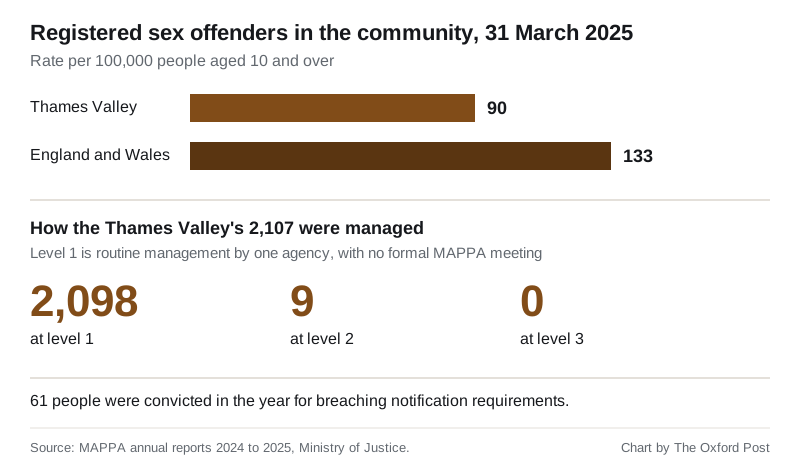
MAPPA publishes an annual count of how many people convicted of sexual offences are living in each police area, and at what level of oversight. The Thames Valley report for 2024 to 2025 gives the position on 31 March 2025:
- 2,107 people subject to sex offender notification requirements and living in the community across Berkshire, Buckinghamshire and Oxfordshire
- 2,098 of them managed at level 1, which means ordinary management by a single agency with no formal multi-agency meeting
- nine at level 2, none at level 3
- 194 Sexual Harm Prevention Orders in force for that group
- 61 people convicted during the year for breaching their notification requirements, and seven cautioned
- 11 had a lifetime notification requirement revoked on application
Two honest caveats. The Thames Valley’s rate, 90 per 100,000 people aged 10 and over, is well below the 133 per 100,000 recorded across England and Wales in the national MAPPA report. And the concentration at level 1 is not an Oxfordshire quirk: nationally, 95,639 of 97,050 MAPPA-eligible people were managed at level 1 on the same date. The system is built that way everywhere.
What is specific to here is the inspectors’ finding that requests to move people up from that bottom level are mostly being turned down.
A local audit few people saw
In May the safeguarding partnership published a summary of a multi-agency audit of child exploitation in Oxfordshire. It reviewed how agencies responded to ten children between August 2024 and January 2025, with children’s social care, education, the integrated care board, Oxford University Hospitals, Oxford Health, probation and Thames Valley Police all taking part.
It found good things: timely referrals for some children, good examples of information sharing, some high-quality assessments. It also found “missed opportunities for earlier intervention”, assessments that lacked holistic analysis, plans that were not specific or time-bound, and management oversight that was “not always visible or effective”.
One line stands out against the 2015 review. The audit records “examples where support was stepped down due to non-engagement”, and its recommendation is blunt: “Do not step-down support due to non-engagement; adapt services to maintain support.”
What it means for you
If you were abused in Oxfordshire, at any time, there are two separate routes and they do different things.
- To report to the police, contact Thames Valley Police on 101 or through its website. The force’s published position is that reports of non-recent abuse will be taken seriously and investigated.
- To tell the national inquiry, use the National Listening Exercise form. You do not have to report to the police to do this, and you do not have to give evidence formally. The inquiry’s own criteria say what you send feeds into which areas it investigates next.
For support in Oxfordshire that is independent of both, Survivor Space Oxfordshire, the county’s rape crisis centre, offers free counselling, peer groups and independent sexual violence adviser support. Its number is 01865 965201 and its email is admin@survivorspace.org.uk. The February inspection singled out the children and young person’s independent sexual violence adviser service as “highly valued”, while noting it is working at the edge of its capacity because of court delays.
If you are worried about a child now, Oxfordshire’s multi-agency safeguarding hub is the route for professionals and the public. In an emergency, call 999.
If you want Oxford considered by the inquiry, the mechanism is the evidence, not a petition. The selection criteria list survivor accounts, previous reviews with unresolved issues, and public concern as factors, and say the inquiry may also pick areas “where there has been an absence of previous investigation despite significant public concern”.
We will report the next round of local investigations when the inquiry names them. Every document quoted above is linked, so you can read it yourself.
Sources
- The Statutory Independent Inquiry into Grooming Gangs, Local Area Investigations, checked 23 September 2026
- The Statutory Independent Inquiry into Grooming Gangs, Local Area Investigation Selection Criteria, June 2026
- The Statutory Independent Inquiry into Grooming Gangs, Inquiry announces first local investigations and national hearings, 24 June 2026
- The Statutory Independent Inquiry into Grooming Gangs, National Listening Project
- Thames Valley Police, Response to Panorama: Grooming Gangs, Why were we ignored?, 21 September 2026
- Ofsted, CQC, HMICFRS and HM Inspectorate of Probation, Joint targeted area inspection of Oxfordshire, inspection 9 to 13 February 2026, letter published 14 May 2026
- Oxfordshire Safeguarding Children Partnership, Audit Summary: Child Exploitation, May 2026
- Oxfordshire Safeguarding Children Partnership, Annual Report 2025-26, 12 August 2026
- Ministry of Justice, Thames Valley MAPPA annual report 2024 to 2025 and MAPPA Annual Report 2024/25, published 30 October 2025
- Survivor Space Oxfordshire, checked 23 September 2026
Have your say