
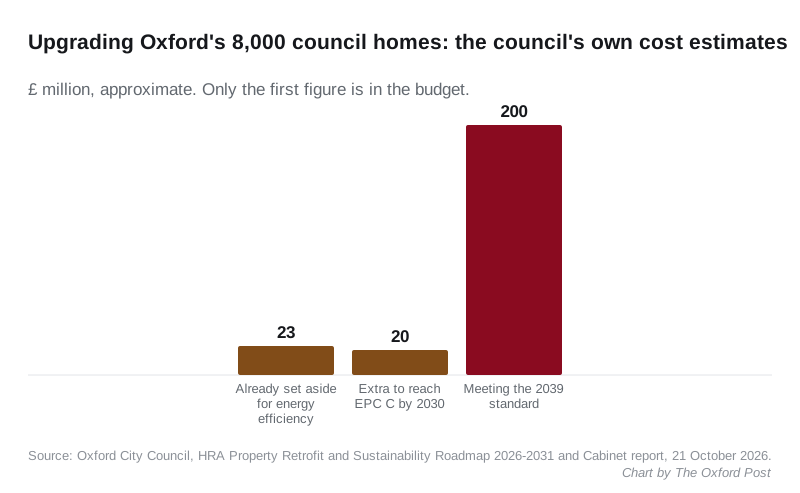
Oxford City Council needs about 500 homes a year insulated to hit EPC C by 2030, £20m beyond its budget, and puts a later 2039 standard at £200m it has not got.
Bringing Oxford’s 8,000 council homes up to the energy standard the government will require in 2039 could cost about £200 million, money the council says it has not set aside. The estimate is in a new five-year plan for the city’s council housing.
The nearer target is cheaper but still not fully funded. To get 95% of homes to an Energy Performance Certificate (EPC) rating of C by 2030, the council expects to need around £20 million on top of the repairs it already plans.
Oxford City Council’s Cabinet backed the HRA Property Retrofit and Sustainability Roadmap 2026-2031 on 21 October. The council announced it on 29 October.
Backing the plan does not approve any spending. The Cabinet report says each programme must still come back through the budget.
Why it has to happen
The government has set new minimum energy standards for social housing. Under them, council homes must reach EPC band C by 1 April 2030, unless an exemption applies. A second, tougher test follows from 1 April 2039.
Around 81% of Oxford’s emissions come from buildings, the council says, and homes are the largest share of that.
The numbers in the plan
The roadmap and the Cabinet report say:
- About 500 homes a year need retrofitting to stay on track for 2030.
- Past programmes cost about £25,000 a home to reach band C, before project management fees.
- The housing capital programme already holds about £23 million for energy efficiency. The report warns this “should not yet be treated as confirmation that the full programme is funded”.
- The extra cost of reaching band C is put at about £20 million.
- The 2039 standard could need about £200 million more. That is “not currently provided for” and would need “substantial external government funding”.
- Swapping about 500 gas boilers a year for low-carbon heating would cost about £12 million a year more than new boilers. That is not funded either.
The homes that are hardest to fix
The council says it cannot treat its homes as a few standard types. When it tried, it found “100s of sub types”, each needing different work. Its roadmap lists:
- 32% of homes are flats, in 411 blocks. Those need a whole-block approach, including leaseholders.
- 13 blocks have communal heating and 5 are tower blocks, each needing its own plan.
- Over 30% of homes are solid-walled or system-built, which are hard to insulate.
- Just under 300 homes have no EPC at all, and many others have expired ones.
- About 550 homes rated D or below are not in the current five-year capital programme.
It also admits its records are patchy. Some homes have had work that their certificate does not show, and some are logged as the wrong type of building.
What happens next
The council’s action plan commits it to:
- finishing 212 homes to band C through the government-funded Social Housing Decarbonisation Fund, wave 2.1
- insulating 100 homes in 2026/27 and 200 in 2027/28, depending on surveys and access
- commissioning new EPCs where certificates are missing or out of date
- drawing up a costed plan for every home rated D or below
What it means for you
- If you rent from the council, the plan aims for warmer homes that are cheaper to heat. It favours “fabric first” work: insulation, windows and ventilation before new heating.
- Expect a survey. Each home needs its own assessment before work starts, and the plan depends on access to homes.
- New lets. The council says it will not let a home rated below D where improvement is cost-effective and technically possible. From 2030 that bar rises to C.
- Damp and mould can be reported to the council’s housing team now. The council’s spending on it this year is already over budget.
Sources
- Oxford City Council, HRA Property Retrofit and Sustainability Roadmap and Action Plan 2026-2031, Cabinet 21 October 2026, Appendix A
- Oxford City Council, Cabinet report, agenda item 14, 21 October 2026
- Oxford City Council, Cabinet backs roadmap for warmer, greener council homes, 29 October 2026
Have your say