
Seven of the 30 planning applications Oxford validated last week involve an HMO. The addresses, the council's 20% rule, and the dates to comment by.
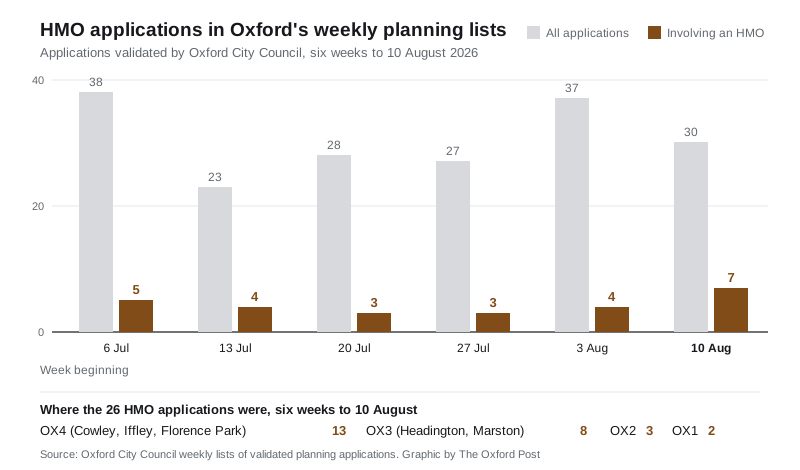
Seven of the 30 planning applications Oxford City Council validated in the week beginning 10 August involve a house in multiple occupation, and six of the seven are in east Oxford. Neighbours have until early September to comment on most of them. (Oxford City Council, weekly list of validated applications, week beginning 10 August 2026)
That is the sharpest week of the summer so far. We read the council’s own weekly lists for the six weeks to 10 August, 183 applications in total, and counted 26 that involve an HMO in some form. That is one application in seven across the period, rising to almost one in four last week.
The seven applications
All seven are registered and undecided. The references link to the council’s planning portal, where the drawings, the officer and the comment box all sit on one page.
- 156 Fern Hill Road, OX4 2JR. Change of use of a house to a C4 HMO, with bin and cycle storage. Validated 30 July, comments close 3 September. (26/01837/FUL)
- The Mish, 57F St Clement’s Street, OX4 1AG. Change of use of the basement from community meeting and youth work space to a C4 HMO, with three replacement doors on the east elevation and altered windows. Validated 3 August, comments close 7 September. (26/01865/FUL)
- The Mish, 57F St Clement’s Street, OX4 1AG. The matching listed building consent for the same scheme, covering internal alterations to the basement to form a bathroom, kitchen and living facilities. Validated 3 August, comments close 7 September. (26/01866/LBC)
- 11 Broadhead Place, OX3 9RE. Change of use of a house to a large HMO, the seven-occupier-and-above category, with cycle and bin storage. Validated 3 August, comments close 7 September. (26/01873/FUL)
- 18 Florence Park Road, OX4 3PH. Change of use of a house to a C4 HMO, with bin and bike stores. Validated 5 August, comments close 9 September. (26/01884/FUL)
- 18A Florence Park Road, OX4 3PH. The same proposal for the property next door, lodged on the same day. Validated 5 August, comments close 9 September. (26/01885/FUL)
- 86 Magdalen Road, OX4 1RE. Not a proposal to change anything: an application for a certificate that the existing use as a C4 HMO is lawful. (26/01889/CEU)
That last one works differently from the rest, and it is worth knowing why. A lawful development certificate is a legal test of what is already happening on the ground, not a judgement on whether it is a good idea. Government guidance is blunt about it: “planning merits are not relevant at any stage in this particular application or appeal process”. (Ministry of Housing, Communities and Local Government, planning practice guidance on lawful development certificates, paragraph 009)
Why Oxford sees so many of these
In most of England, turning a family home into a small shared house for three to six tenants needs no planning permission at all. Oxford is not most of England. An Article 4 direction has been in force across the whole city since February 2012, and it removes that freedom, so a change from a C3 dwelling to a C4 HMO here needs a full application. Going from six occupiers to seven or more needs one everywhere. (Oxford City Council, planning control for houses in multiple occupation)
Once an application is in, the council applies a numerical test that few other authorities use so plainly. Policy H6 of the adopted Oxford Local Plan 2036 says permission for a C3 to HMO change will only be granted where “the proportion of buildings used in full or part as an HMO within 100 metres of street length either side of the application site does not exceed 20%”. The plan spells out that street length counts the frontage either side of the site, the frontage opposite it, and the buildings facing those frontages. (Adopted Oxford Local Plan 2036, Policy H6, page 43)
The plan is candid about why the rule exists, and about how large the sector already is here. It estimates that 20% of Oxford’s population lives in an HMO, and says high concentrations in some areas are “resulting in changes to the character of the local area” and can contribute to parking problems and large numbers of transient households.
Geography follows the same pattern in our count. Of the 26 HMO applications in the six weeks to 10 August, 13 were in OX4 and 8 in OX3, so 21 of 26 sat in the Cowley, Iffley, Florence Park, Headington and Marston side of the city. OX2 had three and OX1 two.
The licensing rule that changed in June
Planning is only half of it. A separate scheme decides whether a landlord may legally let the house at all, and Oxford renewed it this year. The Oxford City Council Designation of an Area for Additional Licensing of Houses in Multiple Occupation 2026 was made on 25 March 2026, came into force at midnight on 25 June 2026 and runs to 25 June 2031. It covers the whole council district, and it catches the HMOs that fall outside mandatory national licensing: those with three or four occupiers, and self-contained flats in multiple occupation whatever the number of storeys. (Oxford City Council, HMO area designation 2026)
In practice that means a small Oxford HMO can need two separate green lights, one from planning and one from licensing, and a landlord who has secured neither is exposed on both fronts. The city prosecutes on the licensing side: on 31 July the council reported a £23,138 penalty against an Oxford landlord over an unlicensed rented property in Headington. (Oxford City Council, 31 July 2026)
What it means for you
If you live near one of these addresses, you can comment, and the deadlines above are real: 3 September for Fern Hill Road, 7 September for St Clement’s Street and Broadhead Place, 9 September for the two Florence Park Road houses. Comments go through the application page on the council’s portal. The arguments that carry weight are planning arguments: the 20% concentration test, parking and cycle storage, bin storage, noise and the space standards in Policy H15. A comment that simply objects to renters is not a planning argument and will not help.
If you are thinking of letting a house as an HMO here, check the concentration figure before you buy or convert. The 100-metre street-length test is the thing that most often stops these applications, and it is measured before your application is decided, not after.
If you are renting a room in one, the June 2026 designation means most small Oxford HMOs now need a licence. The council keeps a public register of licensed HMOs, and a licence carries conditions on safety and management.
We check the council’s weekly planning list every week. Our running summary of what has been lodged and decided is on our Oxford planning news page, and if you are weighing up the cost of buying rather than sharing, our Oxford house prices page has the ward-by-ward figures from Land Registry sales.
Have your say