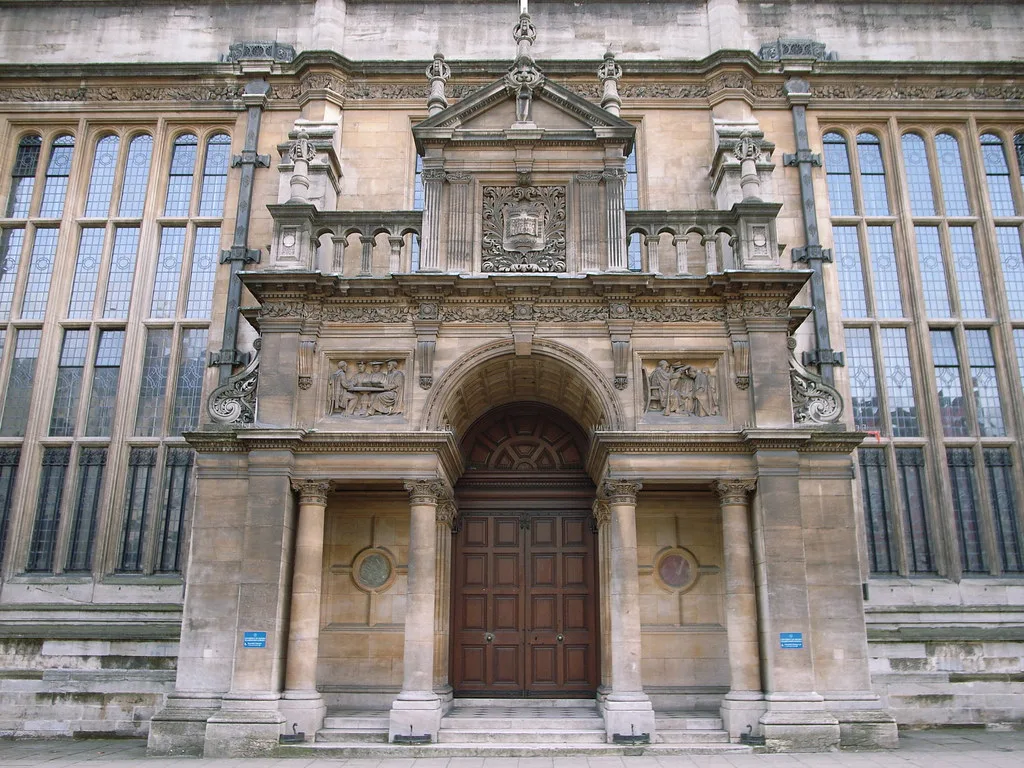

Oxford is fifth in the Good University Guide 2027, down from joint fourth. Its own students rank it last in the Russell Group for being listened to.
The University of Oxford has been ranked fifth in The Times and Sunday Times Good University Guide 2027. Last year it was joint fourth. The guide was published on Friday 18 September.
The University of St Andrews is top. It says this is the third time in six years it has led the table.
The top five:
- University of St Andrews
- London School of Economics
- Imperial College London
- University of Cambridge
- University of Oxford
(University of St Andrews, 18 September 2026; Imperial College London, 18 September 2026)
Imperial was also named University of the Year 2027, Medical School of the Year and University of the Year for Graduate Employment. St Andrews was named Scottish University of the Year and runner-up for University of the Year for Teaching Quality.
Last year’s table was the first in the guide’s 32-year history in which neither Oxford nor Cambridge finished in the top three. Both were joint fourth, behind LSE, St Andrews and Durham. (University of St Andrews, 19 September 2025)
Neither the University of Oxford nor Oxford Brookes University had published anything about the 2027 table on its news pages by Friday afternoon.
What the table measures, and what we can check
The guide ranks UK universities on student satisfaction with teaching quality and with the wider student experience, entry standards, research quality, sustainability and graduate prospects. The 2025 edition ranked 134 universities. (Oxford Brookes University, 20 September 2024; University of York, 2026)
The full table sits behind The Times’ paywall, so we cannot show you the scores behind Oxford’s fifth place, and we cannot tell you where Oxford Brookes finished this year.
The satisfaction half of it is public, though. It comes from the National Student Survey, which the Office for Students runs among final-year undergraduates and publishes in full for free. We downloaded the 2026 provider-level results and pulled out both Oxford universities.
Oxford is first in the Russell Group for teaching and last for being heard
The pattern in Oxford’s own students’ answers is stark.
Of the 24 Russell Group universities, Oxford scores:
- highest of all 24 on teaching on my course, at 94.4%
- lowest of all 24 on organisation and management, at 73.0%
- lowest of all 24 on the student voice theme, at 67.3%
- lowest of all 24 on whether it is clear that feedback is acted on, at 45.9%
- lowest of all 24 on whether the students’ union represents students’ academic interests, at 44.5%
- second lowest of the 24, ahead of only Cambridge, on whether marking criteria were clear, at 58.3%
Widen it to the whole country and the bottom scores hold. Among the universities and colleges where at least 500 undergraduates answered, Oxford is last of 151 on the student voice theme, last of 150 on feedback being acted on, last of 143 on the students’ union question and second lowest of 151 on marking criteria.
The top end is just as real. Oxford is eighth of those 152 institutions on teaching, 97.7% of its undergraduates say their course is intellectually stimulating, and 97.9% rate the library resources. England’s averages this year were 88.1% for teaching, 81.1% for organisation and management and 80.2% for the student voice. (Office for Students, 8 July 2026)
The two Oxford universities, side by side
Both are in the same survey, so they can be compared directly. These are the seven NSS themes for all undergraduates in 2026.
| Theme | University of Oxford | Oxford Brookes |
|---|---|---|
| Teaching on my course | 94.4% | 87.7% |
| Learning opportunities | 87.0% | 86.4% |
| Assessment and feedback | 77.6% | 83.5% |
| Academic support | 93.5% | 90.3% |
| Organisation and management | 73.0% | 83.3% |
| Learning resources | 95.2% | 86.9% |
| Student voice | 67.3% | 79.2% |
Brookes comes out ahead on three of the seven, and by more than ten points on organisation and management. Oxford is ahead by nearly seven points on teaching and by more than eight on learning resources.
The caveats, in full
Four things are worth knowing before anyone uses these numbers to pick a university.
- Oxford’s sample is thinner. At Oxford 1,638 of 3,032 eligible undergraduates answered, a published response rate of 54%. The university’s own page gives the 2026 rate as 53.8%. At Brookes it was 2,115 of 2,952, or 71.6%. Across the UK, 71.8% of eligible final-year undergraduates responded, more than 360,000 students.
- The benchmark is not a plain average. The Office for Students publishes a benchmark for each provider, adjusted for its mix of subjects and students. Oxford is below its own benchmark by 20.0 points on feedback being acted on, by 28.4 points on the students’ union question and by 16.4 points on marking criteria.
- The students’ union question is one question. Oxford SU says it represents more than 26,000 students across 39 colleges and six permanent private halls, and that it works alongside JCR and MCR representatives through its Conference of Common Rooms. The survey does not ask about college common rooms. (Oxford SU)
- The survey and the table are not the same thing. The guide combines satisfaction with entry standards, research quality, sustainability and graduate prospects, and it does not publish the weightings on its free pages. We are not claiming these NSS scores explain Oxford’s fifth place. They are what Oxford’s own students said in the most recent national survey.
What it means for you
- If you are applying this autumn: you do not need a subscription to compare courses. The Office for Students publishes every provider’s NSS results in full, and Discover Uni shows them course by course alongside earnings and continuation rates. Oxford’s own deadline is earlier than most: applications for 2027 entry must be in by 6pm UK time on 15 October 2026.
- If you are a final-year undergraduate at either university: the 2027 survey normally opens in January. This year’s ran from 22 January to 30 April. Oxford’s results are published because it passed the 50% response threshold.
- If you are an Oxford resident: term starts next month, and this year the city’s transport changes with it. Our guides to the new bus network from 20 September and the traffic filters starting 28 September cover what changes and when.
- If you want the raw data: we used the “All modes of study” summary workbook from the Office for Students NSS 2026 release, at provider level, all undergraduates. The national comparisons above count only institutions with at least 500 responses to the question, because small providers with a few dozen answers swing wildly.
Neither university has commented publicly on the 2027 table. If either does, we will add it here.
Have your say