
Government analysis of 4,676 replies scores the approved three-council plan 37% positive, 50% negative. Named consultees ranked it last of three.
Update, 14 September 2026: the reorganisation described below has been paused. On 7 September ministers told council leaders to stop implementing the July decisions while the whole programme is reviewed, and Oxfordshire is one of the 14 July decisions under review. The 1 April 2028 date and the May 2027 elections to the new councils are no longer settled. See Oxford council reorganisation paused: work ordered to stop.
The government’s own analysis of the consultation that preceded the abolition of Oxford City Council has been published, and it shows that the plan ministers chose drew more opposition than support, and that the councils, health bodies and police forces formally asked for their views ranked it last of the three options on the table. (MHCLG, Oxfordshire: summary and analysis of consultation responses, 22 July 2026)
The statutory consultation ran from 5 February to 26 March 2026 and drew 4,676 responses. When Oxford City Council announced the decision on 16 July it said the results were expected “in the coming days”. They were published on 22 July. The council has published nothing about them on its news feed in the four weeks since.
On 16 July the Housing Secretary, Steve Reed, decided to implement the three-council plan submitted by Oxford City Council, with West Berkshire added to the southern unitary. Oxford City Council and the six other councils in Oxfordshire and West Berkshire will be abolished on 1 April 2028. (MHCLG, decision letter to Oxfordshire council leaders, 16 July 2026)
What the 4,676 replies actually said
The analysis averages answers across the multiple-choice questions, eight per proposal, with an extra question where a proposal involved a boundary change, then reports the share that were positive and negative. These are shares of answers rather than headcounts of people, because respondents could comment on all three proposals. On that measure no option was endorsed by a majority, and every option drew more negative answers than positive ones.
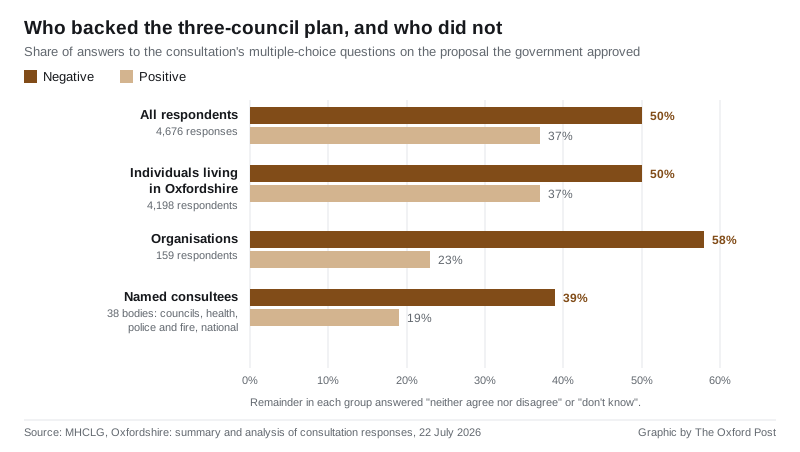
For the three-council plan, 37% of answers were positive and 50% negative. The single-council plan put forward by Oxfordshire County Council scored 37% positive and 51% negative. The two-council plan from the four district councils scored 32% and 53%.
Among the 4,198 respondents who said they live in Oxfordshire, the three-council plan scored 37% positive and 50% negative, the same as the overall figure.
The sharper split is among organisations and named consultees. Named consultees are the bodies the Secretary of State is required by law to consult: 38 responded, including seven principal councils, nine neighbouring councils, two health bodies, three police and fire bodies, four other public sector organisations, five voluntary and community sector bodies and five national bodies. They rated the approved plan lowest of the three, at 19% positive and 39% negative, against 31% positive and 29% negative for the two-council plan. The analysis states their “preference in order is for the 2 unitary proposal followed by the 1 unitary proposal then the 3 unitary proposal”.
The 159 organisations that responded showed the same pattern more strongly: 23% positive and 58% negative on the approved plan, against 42% positive and 34% negative for the two-council plan.
Two things are worth saying plainly about these numbers. A consultation of this kind is not a vote, and the government never said it would follow one; the Secretary of State assessed the proposals against published criteria, and his letter sets out at length why he judged the three-council option best for housing growth, for Oxford’s economic geography and for any future devolution deal. Ministers also used an AI tool called Consult to help identify themes in the responses, though the department says human reviewers checked its work and that every named consultee response was read by officials.
The decision letter also concedes a point the council’s own announcement did not: the chosen option “may take longer than the other proposals to payback the upfront costs of reorganisation”. Oxford City Council says the plan will save £48.6m a year across Oxfordshire and West Berkshire by year five. (Oxford City Council, 16 July 2026)
The name is North Oxfordshire, not Northern
A second document, sent to the seven chief executives on 20 July, sets out the decisions ministers have taken for the legal order that will create the councils. It confirms the legal names and the number of councillors: (MHCLG, implementation letter to Oxfordshire chief executives, 20 July 2026)
- Greater Oxford Council, 72 councillors: Oxford, plus 15 parishes from Cherwell, 25 from South Oxfordshire and nine from the Vale of White Horse
- North Oxfordshire Council, 73 councillors: West Oxfordshire and most of Cherwell
- Ridgeway Council, 88 councillors: West Berkshire and the rest of South Oxfordshire and the Vale of White Horse
The council’s announcement called the northern authority “Northern Oxfordshire Council”, which was the name used in the proposal. It cannot be called that. The letter says it is “not possible to use the ‘-ern’ suffix, for example ‘Northern’, or to include dashes in council names”. Nor can “City” appear in a legal name, because city status is granted by the monarch and not by a council’s title. A new council can rename itself later under section 74 of the Local Government Act 1972 if two-thirds of members voting at a meeting called for the purpose agree, and any council can trade under a different name for branding.
That leaves a live question for Oxford. City status attaches to a defined locality, and the letter says that where the council structure no longer matches the area originally granted it, Charter Trustees are “the usual legislative solution”, able to hold historic property such as charters and insignia on behalf of the area. The detail is left to later legislation.
Today is a deadline
The implementation letter gives the seven councils until 17 August to send four things to the ministry: which council’s head of paid service should be returning officer for each new area, suggested interim ward boundaries for each new council, the current election cycles for parish councils and how they should be aligned, and which council should receive the transition grant.
17 August is also the last date ministers said they would consider “any further unanimous representations” on matters already decided, such as the names and the councillor numbers. Any change would have to be agreed by every affected council in that new council’s area, and the final decision rests with the Secretary of State.
The money attached is £900,000 for each new council, £2.7m across Oxfordshire and West Berkshire, paid this financial year through section 31 grants. Separately, ministers committed up to £10m nationally on 16 July for children’s services, adult social care and public health capacity, from an existing £63m fund, including up to a further £150,000 per new council.
What happens next, and when
- September 2026: the ministry expects to share a draft Structural Changes Order with the councils for factual checking
- Autumn 2026: a joint committee is set up for each new council. Greater Oxford’s will have 11 members: four from Oxfordshire County Council, four from Oxford City Council and one from each of the three other affected districts. The ministry expects joint committees to meet regularly for up to six months before the elections
- 2027: the order is expected to be made, after scrutiny by the Joint Committee on Statutory Instruments and the Lords’ Secondary Legislation Scrutiny Committee, a debate in each House and approval motions in both
- May 2027: elections to the three new councils, replacing any local elections scheduled for that date. Sitting councillors have their terms extended. The elected members sit as “shadow” councils, preparing budgets and plans but not running services
- 1 April 2028: the new councils take over every service, and the seven existing councils are abolished
The letter also flags a control that will bite before then. Once the order is in force, ministers expect to issue a direction under section 24 of the Local Government and Public Involvement in Health Act 2007 requiring the existing councils to get their shadow council’s consent before entering certain contracts or disposing of certain assets, so that commitments made in the run-up cannot undermine the new councils’ finances.
What it means for you
Nothing changes about your bins, your council tax bill or your planning application yet. Until 1 April 2028 Oxford City Council and Oxfordshire County Council remain responsible for exactly what they are responsible for now, and both are under a duty to co-operate through the transition. Our Oxford planning news page tracks what the city council is deciding week by week.
Your next local election is likely to be in May 2027, and it will be for a council that does not exist yet. Those elections replace whatever was scheduled, and they will be fought on interim ward boundaries drawn this month, not on a full boundary review. The Local Government Boundary Commission for England will review wards properly before the following elections.
If you have a view on the ward boundaries, this month is when they are being drawn. The councils were asked to submit them by 17 August, ideally agreed between the councils in each new area, with the final say resting with ministers.
If you live in one of the 49 parishes being moved into Greater Oxford, your district council changes as well as your county council: 15 parishes come from Cherwell, 25 from South Oxfordshire and nine from the Vale of White Horse. Reading Borough Council raised an interest in three wards in the east of West Berkshire; the Secretary of State said that is a matter for the boundary commission, and affected councils can ask it for advice.
One further point from the decision letter, for anyone following the argument about size: all three new councils will have fewer than 500,000 residents. The Secretary of State wrote that the 500,000 figure “has always been a guiding principle, not a fixed threshold” and that he was satisfied councils below it were justified here.
Have your say