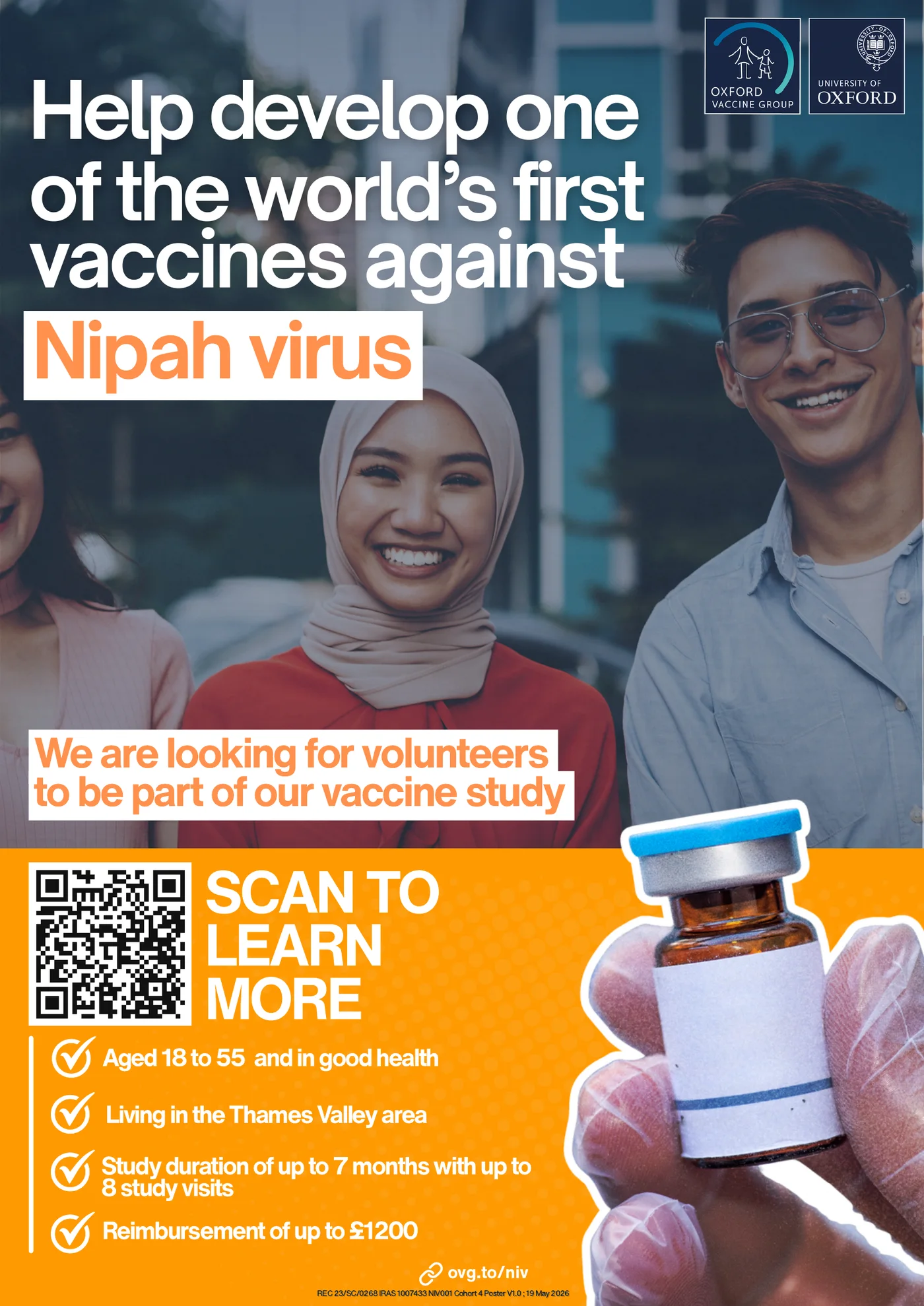

The Oxford Vaccine Group needs up to 20 healthy adults aged 18 to 55 in the Thames Valley for its Nipah study, with reimbursement of up to £1,200. Updated November 2026.
The Oxford Vaccine Group is looking for up to 20 healthy adults to join its trial of a Nipah virus vaccine at the Churchill Hospital in Headington. Volunteers must be aged 18 to 55, weigh over 50kg and live in the Thames Valley. The group offers reimbursement of up to £1,200 for time, travel and inconvenience.
The group, part of the University of Oxford, asked The Oxford Post to help it reach people who might take part. Its own appeal reads:
“Help us develop a vaccine against Nipah virus! We are looking for volunteers to take part in a new vaccine trial at the Oxford Vaccine Group. If you are aged 18 to 55, in good health, weigh over 50kg and live in the Thames Valley area, you may be eligible to take part.”
What the vaccine is
The vaccine is called ChAdOx1 NipahB and was developed by the University of Oxford. The participant information sheet says it is similar to the Oxford/AstraZeneca COVID-19 vaccine, but targets a part of the Nipah virus instead.
The only piece of Nipah in it is the genetic code for one protein the virus uses to invade cells. Nipah virus itself is not used to make the vaccine. “You cannot catch Nipah from the vaccine,” the information sheet says.
The trial, called NIV001, is a phase I study of safety and immune response. Its first part ran in 2024 and was the first time the vaccine had been given to people. The group estimates that around 300 people have since received it, in the UK and in a trial in Bangladesh. The study is sponsored by the University of Oxford and funded by the Coalition for Epidemic Preparedness Innovations (CEPI).
Why Nipah
On its study page, the Oxford Vaccine Group describes Nipah as “a potentially fatal viral disease that can cause severe breathing and nervous system problems”. It was first identified in an outbreak in Malaysia and Singapore in 1999. The group says it still causes outbreaks every year in Bangladesh and “has the potential to cause a pandemic”.
The World Health Organization and other expert groups have named it a very high priority for faster vaccine development, the group says.
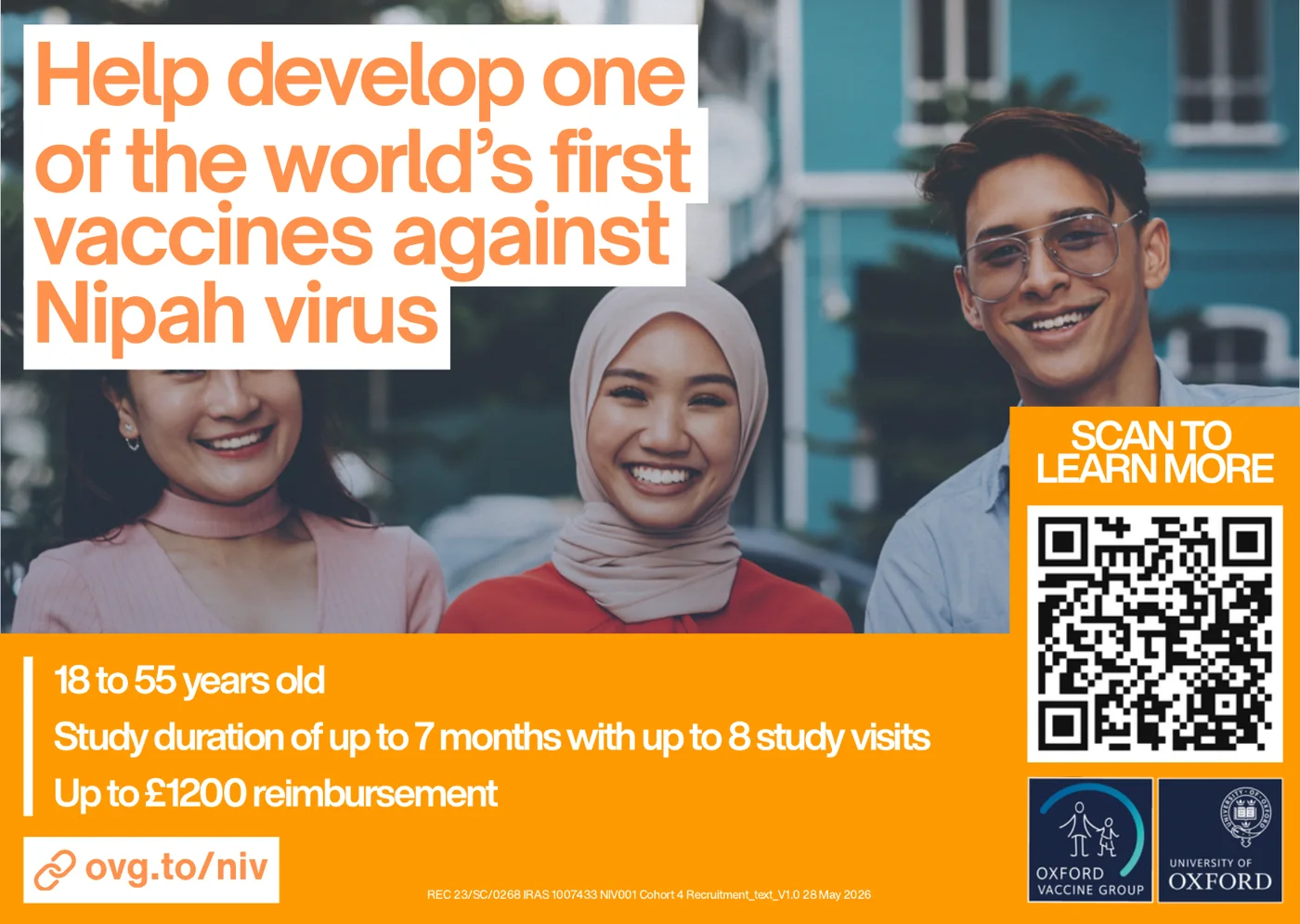
What this part of the study is for
Sixty-one people took part in the earlier groups. This new group, cohort 4, is mainly about collecting plasma, the liquid part of the blood. Plasma carries the antibodies the body makes after a vaccine.
Studying it will help the team understand how the vaccine might protect against infection, the information sheet says. Some of that work may involve animal studies approved by an independent ethics committee.
What taking part involves
Volunteers in cohort 4 know from the start that they will get two doses of the vaccine, 12 weeks apart. The study lasts up to seven months and includes:
- a screening visit, with a medical history, examination and blood test
- two vaccination visits at the Churchill Hospital, each about two hours
- two or three plasma donations
- three follow-up visits
- an online symptom diary for 28 days after each dose
The vaccinations and checks are at the Centre for Clinical Vaccinology and Tropical Medicine on the Churchill Hospital site, OX3 7LE. The plasma donations are not in Oxford: they take place at the NHS Blood and Transplant donor centre in Reading Bridge House, Reading. A machine draws blood, keeps the plasma and returns the rest to the donor through the same line.
Only three to five volunteers will be asked to give plasma before their first dose.
Reimbursement
| Visit | Reimbursement |
|---|---|
| Screening visit | £110 |
| Each vaccination visit | £110 |
| Each follow-up visit | £90 |
| Each plasma donation | £180 |
| Each completed symptom diary | £30 |
Someone who completes every visit receives £1,020 with two plasma donations, or £1,200 with three. Any unscheduled visit adds £90.
What it means for you
You may be able to take part if you:
- are aged 18 to 55 at your screening visit and in good health
- live in the Thames Valley area
- weigh at least 50kg
- are eligible to give blood or plasma
The information sheet lists several things that rule people out. They include:
- ever having had the Oxford/AstraZeneca COVID-19 vaccine, also sold as Vaxzevria or Covishield
- being pregnant or breastfeeding during the study
- a new tattoo, piercing or acupuncture in the past four months
- having been told you can never give blood or plasma
The screening includes confidential questions about sexual history, drug use and travel, as every plasma donor is asked. A study doctor goes through the full criteria with each volunteer.
The first step is an online questionnaire, which is linked from the NIV001 study page and the short address ovg.to/niv. Questions go to the study team at info@ovg.ox.ac.uk or on 01865 611400. The group says it can also send paper copies of its posters and leaflets to anyone willing to put them up at work.
Have your say