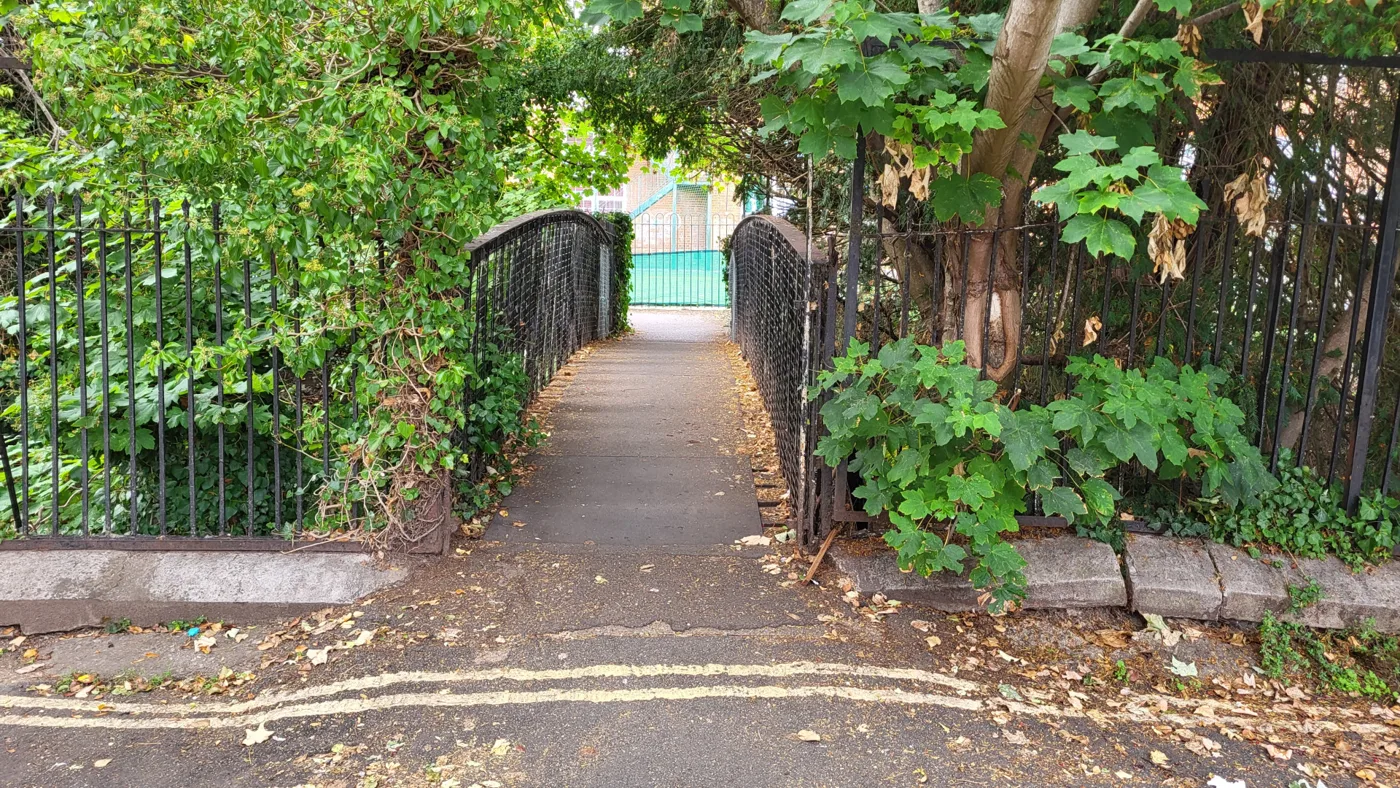

The Swan Street footbridge on Osney Island closed on 24 September, adding about 10 minutes to walks. It is Oxford's second shut on safety grounds since May.
The footbridge at the end of Swan Street on Osney Island has been closed on safety grounds. Oxfordshire County Council announced it at 10.29am on Wednesday 24 September. There is no reopening date.
The bridge carries walkers over the Osney Stream between Swan Street and Ferry Hinksey Road. The council says it is used by residents “including parents and pupils at West Oxford Community Primary School”, which stands on Ferry Hinksey Road.
The council’s notice says the bridge “was closed after Oxfordshire County Council inspectors identified safety concerns with the structure”. It does not say what the inspectors found, how long the bridge had gone without inspection, or what work would be needed to reopen it. (Oxfordshire County Council, 24 September 2026)
The diversion, and what it costs you
The council has published one alternative route:
- from West Street out to Botley Road
- then back round to Ferry Hinksey Road
- about 10 minutes added to most journeys, on the council’s own estimate
Ten minutes each way is a twenty minute round trip. On a school run twice a day that is a different morning.
Councillor Liz Leffman, the county council’s Cabinet Member for Highways Construction and Repairs, said: “We know how popular this footbridge is, and how important it is for this community. However, we cannot compromise when it comes to the safety of the public. The decision to close the bridge has not been taken lightly, but it was the only option in the circumstances.”
Engineers from the council and its principal highways contractor, M Group, will “consider options to reopen the bridge as soon as practically possible”. No timescale is attached to that.
This is the second Oxford footbridge closed this way since May
On 15 May the same council closed the Cottesmore footbridge over the A4142 Eastern Bypass in south Oxford, near the Heyford Hill roundabout. It connects Cottesmore Road to Thomson Terrace and carries people to the Sainsbury’s store. Pedestrians were sent round via the Rose Hill subway.
The wording of the two notices is close to identical. Both say inspectors “identified safety concerns with the structure”. Both end with engineers and M Group considering options. (Oxfordshire County Council, 15 May 2026)
Four months on, the council has published nothing further about Cottesmore. Its newsroom carries no reopening notice and no replacement plan for that bridge.
What the council’s own auditors found in between
Five days after Cottesmore shut, on 20 May, the council’s Audit and Governance Committee received the Annual Report of the Chief Internal Auditor for 2025/26. It contains a separate audit of Bridge Management, with fieldwork carried out in April 2026.
That audit was rated Red, the lowest assurance opinion, and every one of its six risk areas was rated Red as well:
| Risk area | Opinion |
|---|---|
| Governance and strategy | Red |
| Asset management | Red |
| Inspection, maintenance and repairs | Red |
| Contract management | Red |
| Budget monitoring | Red |
| Management oversight and performance monitoring | Red |
It produced 16 management actions, four of them Priority 1. Only two recently finalised audits across the whole council were rated Red that year, and bridge management was one of them.
On inspections, the audit is specific:
- Principal inspections, which the contractor carries out, were under-delivered, with “a longstanding backlog, reducing assurance over bridge condition and safety”, and limited independent oversight of the ones that were completed.
- General inspections, done in-house, “were found to be overdue”, and a backlog had also built up in reviewing and approving the reports that were finished.
- Inspection outcomes and follow-up actions “are not consistently recorded, reviewed, or closed” in BridgeStation, the council’s asset system.
- Bridge reports made through FixMyStreet “are not efficiently managed by the bridges team”, with duplication and manual work.
On the asset records themselves, auditors found duplicate structure records, incorrect coordinates and “widespread missing or inconsistent fields for ownership, maintaining authority, and inspection history”. Management accepted the data was “in its infancy”, with much of it still held offline.
Two further findings matter for anyone waiting on a repair. There was a “material underspend” against the 2025/26 bridges capital programme, reported as slippage, with schemes “reprogrammed, partially completed, deferred, and carried forward”. And although the highways maintenance contract has run since April 2025, no bridge-specific performance indicators had been put in place or monitored, so there was no baseline for inspections, data quality or structural maintenance. (Annual Report of the Chief Internal Auditor 2025/26, pages 39 to 41)
Under the Highways Act 1980, councils have a duty to maintain highways, including structures such as bridges, in a safe condition.
Where the repairs have got to
The council has not stood still on the audit. Its September progress report to the Audit and Governance Committee shows that, as at 10 August 2026, 14 of the 16 agreed actions had been reported as implemented and two had not. (Internal Audit Progress Report, September 2026, appendix 3)
Because the audit was rated Red, the committee sent it to the Audit Working Group for detailed follow-up. That group met on 2 September, chaired by Councillor Roz Smith, with the Director of Environment and Highways present. Its report to the committee on 16 September records that:
- the service “acknowledges that significant action is needed to strengthen the control environment”
- specialist support has been commissioned to identify and deliver the improvements
- that specialist was “expected to report to management by the end of September”
- the group asked for a further update covering “the adequacy of service capacity and specialist skills within the structures function”
(Report of the Audit Working Group, 2 September 2026)
That report is due this month. Nothing in the council’s Swan Street notice connects the two, and we are not claiming a link. What is on the record is that Oxfordshire’s own auditors described a longstanding backlog in bridge inspections in April, and that two Oxford footbridges have since been shut because inspectors found something wrong with them.
What it means for you
If you use the Swan Street bridge:
- Use the West Street, Botley Road and Ferry Hinksey Road route. Allow an extra 10 minutes each way, and more if you are with young children.
- Botley Road itself reopened on 20 September after almost three and a half years, so the diversion is now a through route rather than a dead end. Height clearance under the rail bridge is 4.4 metres, and the cycleways under it run one way. (Our report on the reopening)
- Check before you travel. Live closures and overnight works across the city are on our Oxford roadworks and travel page, which we refresh from the council’s and National Highways’ own data.
- Report a defect you can see. Bridge problems go to the county council through FixMyStreet at fixmystreet.oxfordshire.gov.uk. The audit found those reports are not handled efficiently by the bridges team, so keep your report reference.
- Parking round Osney Island is resident permit controlled. Our parking in Oxford page has the zones and the visitor permit rules.
We will report the reopening from the council’s own notice when one is published, and we will report what the commissioned specialist finds when that reaches the Audit Working Group.
Sources
- Osney Island footbridge closed over safety concerns, Oxfordshire County Council, 24 September 2026
- Diversion in place as Oxford footbridge closes for safety reasons, Oxfordshire County Council, 15 May 2026
- Annual Report of the Chief Internal Auditor 2025/26, Audit and Governance Committee, 20 May 2026
- Internal Audit Progress Report September 2026, Audit and Governance Committee, 16 September 2026
- Report of the Audit Working Group, 2 September 2026, Audit and Governance Committee, 16 September 2026
Have your say